To sell to the Department of Defense, register free in SAM.gov, which assigns your Unique Entity ID and CAGE code, find a military user, then pick a path: SBIR for early R&D, a Commercial Solutions Opening or Other Transaction for working prototypes, or a subcontract with a prime. As of November 14, 2026, an SBIR Phase I pays up to $335,937.
The Department of Defense (DoD), which has also styled itself the Department of War since September 2025, buys through more doors than most founders expect, and the fastest ones are not in the Federal Acquisition Regulation (FAR). This guide lays out the registration steps, compares the main contract paths, and shows how companies in our directory actually got their first and second DoD contracts.
How to sell to the Department of Defense, step by step
- Define the military problem you solve and who owns it. Money flows through program offices, labs, innovation units and, since the fiscal 2026 (FY2026) National Defense Authorization Act, portfolio acquisition executives, which section 1802 of the law makes the senior acquisition officials for groups of programs, according to War on the Rocks' industry guide. A named end user who wants your product is worth more than any registration.
- Register in SAM.gov. You sign in with Login.gov, start an entity registration, and enter tax, banking, ownership and size information plus your NAICS codes. GSA's quick start guide says to leave the CAGE field blank if you do not have one: "we will assign one after your registration is submitted." Foreign companies need an NCAGE code first.
- Wait, and renew. GSA tells applicants to allow up to 12 to 15 business days after submission for the registration to become active. It must be renewed every 365 days. Registration is free; the Federal Service Desk gives free help.
- Pick the contract path that fits your product's maturity (table below).
- Find the solicitation. Contract opportunities post on SAM.gov; DoD SBIR topics on the Defense SBIR/STTR Innovation Portal (DSIP, dodsbirsttr.mil); Defense Innovation Unit (DIU) Areas of Interest on diu.mil; Air Force open topics on afwerx.com.
- Submit, negotiate and deliver, then line up the follow-on: a Phase III award, a production Other Transaction (OT) or a FAR contract. The first award is rarely the one that pays the bills.
The main ways to sell to the military, compared
| Path | Best for | Typical size and speed | Path to production |
|---|---|---|---|
| Small Business Innovation Research (SBIR) and STTR | US small businesses (500 or fewer employees) with early technology | Phase I up to $335,937 and Phase II up to $2,239,578 without waiver (from Oct 16, 2026) | Phase III, which can be sole source with no dollar cap |
| DIU Commercial Solutions Opening (CSO) | Commercial products that already work | Set by the project; DIU says it often awards in 60 to 90 days | Follow-on production without new competition |
| Other Transaction agreement (10 U.S.C. 4021, 4022) | Prototypes, often through a consortium | Any size; approvals above $100M and $500M | Follow-on production if competed and successfully completed |
| DoD commercial solutions opening (10 U.S.C. 3458) | Commercial or nondevelopmental items | Fixed price; Congress notified within 45 days of awards above $100M | Follow-on production, including sole source |
| Broad Agency Announcement (BAA, FAR 35.016) | Research and development not tied to a specific system | Proposals judged by peer or scientific review, not against each other | Usually a new competition |
| GSA Multiple Award Schedule | Commercial products and services with established pricing | Pre-negotiated prices open to federal, state and local buyers | Repeat orders from any agency |
| Subcontract to a prime or a larger startup | Components, software modules, subsystems | Set by the prime | Rides the prime's program |
| Challenge-based buys (Drone Dominance) | Cheap hardware in quantity | Fixed-price OT orders after live fly-offs | Larger orders each phase |
Sources: SBIR ceilings from sbir.gov; statutes from 10 U.S.C. 4022 and 10 U.S.C. 3458; BAA rules from FAR 35.016; MAS from GSA.
Path 1: SBIR, the most common first DoD contract
SBIR was reauthorized through September 30, 2031 by a law signed April 13, 2026, after a lapse that began in October 2025; our SBIR reauthorization explainer covers what changed, and the SBIR award amounts guide has every ceiling. The Air Force's open topics, run by AFWERX, are the busiest door; see how to apply to AFWERX.
The prize is Phase III. TurbineOne, a San Francisco edge AI company founded in 2021, finished a Phase II SBIR and then won a five-year Army SBIR Phase III IDIQ with a $98.9 million ceiling in September 2025 for its Frontline Perception System, Soldier Systems Daily reported. A DIU "success memo" on its prototype was a key factor, the report said. Picogrid won a $9.3 million Air Force SBIR Phase III in February 2026 to connect counter-drone systems at bases, after about a year and a half of work with the service, according to Breaking Defense.
Path 2: DIU, Commercial Solutions Openings and Other Transactions
If your product already works, DIU's Commercial Solutions Opening lets you answer a short Area of Interest with a five-page brief and, if selected, sign a prototype OT agreement. Our DIU CSO guide walks through the brief, pitch and timeline. Swarm Aero won a DIU prototype award in November 2024 for autonomy software in the Replicator drone effort, alongside Anduril and L3Harris, Defense News reported.
OTs sit outside the FAR, so terms such as data rights are negotiated, and the law allows sole-source production after a successful prototype. DoD obligated more than $18 billion through OTs in fiscal 2024, according to GAO. Our Other Transaction authority explainer covers the rules, the consortia that issue many OTs and how protests work.
The clearest recent example of prototype to production: the Army gave Anduril a $99.6 million, 11-month OT in July 2025 to prototype Next Generation Command and Control (NGC2) with the 4th Infantry Division, DefenseScoop reported, and in October 2026 a five-year contract worth up to $1.8 billion, with a $162.8 million base period, to field it starting with I Corps, according to GovCon Wire.
Path 3: Selling through primes and larger startups
Most DoD money reaches small companies as subcontracts. "The F-35 program alone has over 2,100 suppliers, and more than half of these are American small businesses," Pentagon comptroller Jules Hurst said when presenting the FY2027 budget, per the War Department. Large defense startups now act as primes too: Anduril's NGC2 team included Govini, Palantir, Striveworks, Instant Connect Enterprise, Research Innovations and Microsoft.
Teaming is often the fastest route for software modules, sensors, components and materials. The FY2026 NDAA also stops defense-specific rules from automatically flowing down to subcontractors of large primes (section 1824) and makes commercial buying the procedural starting point (section 1822), according to War on the Rocks.
Path 4: Challenge-based buying and production money
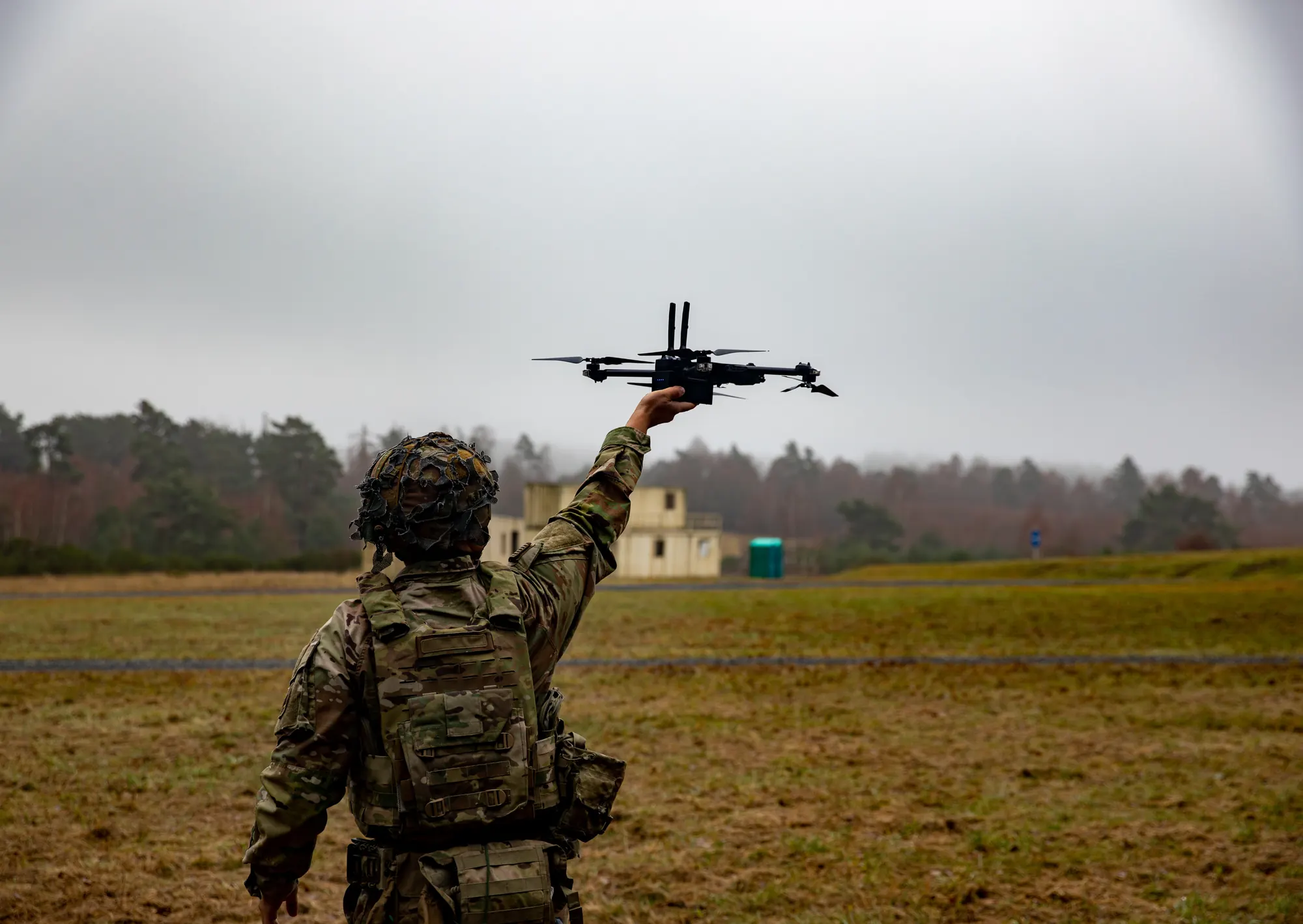
The Pentagon increasingly buys hardware through competitions with posted quantities and prices. The Drone Dominance program buys one-way attack drones through fixed-price OT orders after live Gauntlet fly-offs; ModalAI was among the Gauntlet I order winners. Counter-drone buying runs through Joint Interagency Task Force 401 and its multi-vendor marketplace.
Once you have orders, the Office of Strategic Capital (OSC) can lend against factory expansion. It announced a conditional loan commitment of up to $820 million to Performance Drone Works in July 2026 for drone component production, ExecutiveGov reported. Our OSC loans guide lists every deal.
How long does it take to get a DoD contract?
Registration takes up to 12 to 15 business days. DIU says it often awards CSO prototypes within 60 to 90 days of posting. SBIR timelines from topic release to award vary by component, and a Phase I normally lasts six months, Phase II two years. Production is the long pole: TurbineOne's Phase III came after a completed Phase II, and Anduril's NGC2 fielding contract followed its prototype OT by about 15 months. Budget timing matters too: with the Pentagon on a continuing resolution through December 11, 2026, new programs in the FY2027 request cannot start; see the FY2027 defense budget status.
Mistakes first-time defense sellers make
- Paying for SAM.gov registration. It is free, and the Federal Service Desk helps for free. Third-party services that charge for registration or a CAGE code are not required.
- Letting SAM.gov lapse. An expired registration can block an award or payment; renew every 365 days.
- Chasing solicitations without a user. Briefs scored by DIU or SBIR reviewers are stronger with a named operational need, and transition to production needs a program office that will budget for you.
- Ignoring data rights. SBIR data rights and negotiated OT terms decide who owns your software and drawings; read them before signing.
- Treating the first award as the business. Plan the Phase III, production OT or follow-on contract from the start.
Browse 170 US defense tech startups to see which programs each one has won, or filter by sector, such as drone makers.