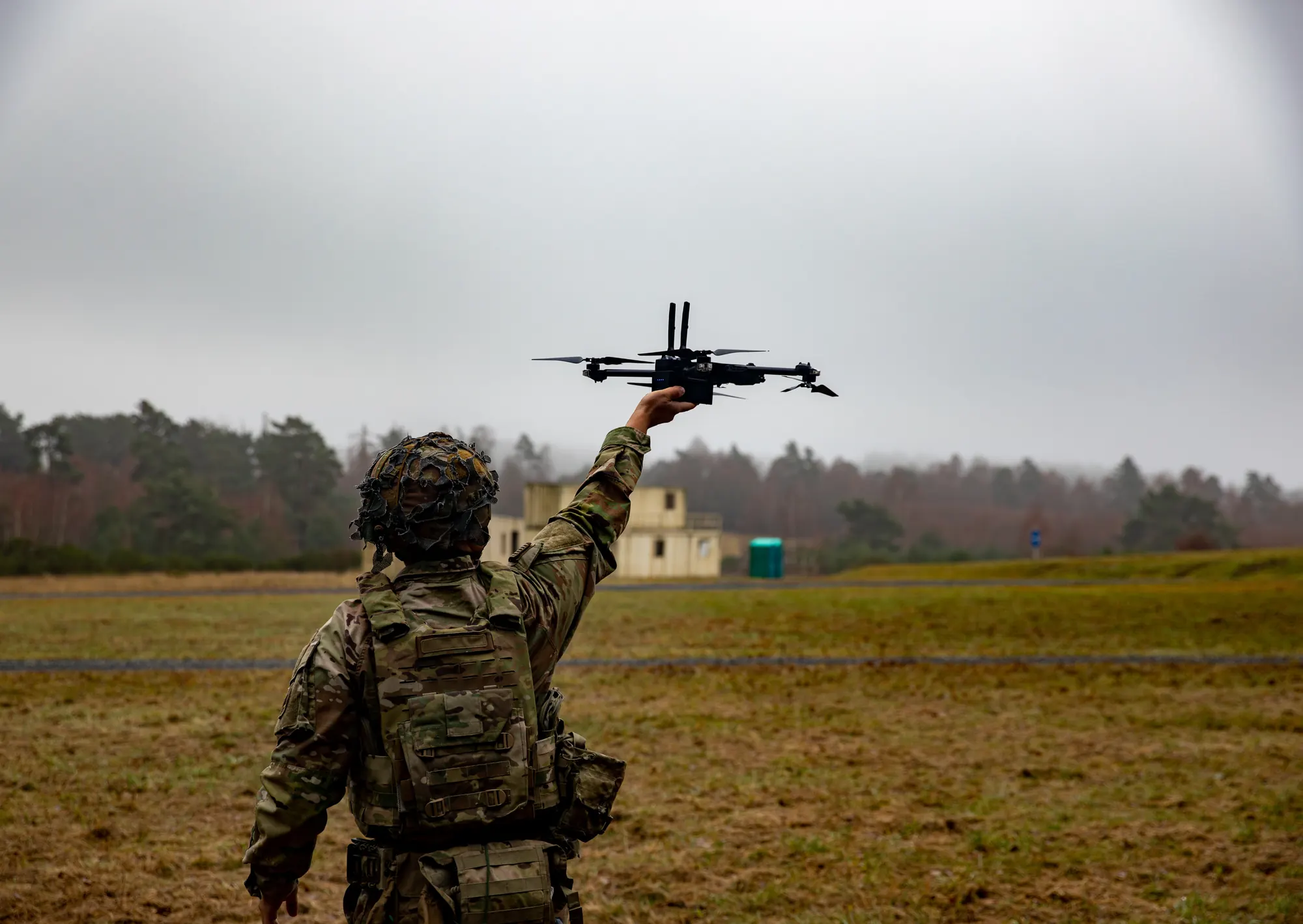
The Drone Dominance Program is a $1.1 billion, two-year Pentagon effort to buy cheap one-way attack drones from US-based supply chains through live "Gauntlet" fly-offs. As of November 14, 2026, it has ordered 30,000 drones from 11 Gauntlet I winners, allocated 60,000 more to nine Gauntlet II winners, and opened Gauntlet 2.5 on November 13.
This explainer covers where the program came from, who runs it, how each phase works, every vendor that has won orders so far, what drones cost under the program, and what comes next in Phase 3. Figures come from the program's own leaderboard and announcements unless stated otherwise.
What is the Drone Dominance Program?
The program executes Executive Order 14307, "Unleashing American Drone Dominance," signed June 6, 2025, and Defense Secretary Pete Hegseth's July 10, 2025 memo, which ordered every Army squad equipped with small one-way attack drones by the end of fiscal 2026 (FY2026) and reclassified small drones as consumables.
According to a War Department article from June 2026, the program is sponsored by the Office of the Secretary of War and jointly administered by the Defense Innovation Unit (DIU) and the Test Resource Management Center (TRMC). The Department of Defense (DoD), which has also styled itself the Department of War since September 2025, describes it as a shift to "challenge-based acquisition" in six-month sprints instead of multiyear programs.
Orders are fixed-price Other Transaction (OT) prototype orders under 10 U.S.C. 4022, solicited through the NSTXL consortium. The program calls itself an "advanced market commitment": it posts quantities and prices before each phase and buys from whoever performs best.
Drone Dominance program timeline
| Date | Milestone |
|---|---|
| Jun 6, 2025 | Executive Order 14307 signed |
| Jul 10, 2025 | Hegseth memo "Unleashing U.S. Military Drone Dominance" |
| Dec 17, 2025 | Program launched with Phase I Request for Solutions (RFS) |
| Feb 3, 2026 | Gauntlet I participants announced |
| Feb to Mar 2026 | Gauntlet I at Fort Benning, Georgia |
| Early Mar 2026 | Gauntlet I leaderboard published; 11 companies selected for orders |
| Apr 21, 2026 | Phase II RFS released |
| Apr 28, 2026 | Supply Chain Framework published (version 2 on Jul 23, 2026) |
| Jun 8 to 19, 2026 | Phase II qualifier at Camp Grayling, Michigan: 49 companies, about 79 drones |
| Jul 1, 2026 | 19 companies advance to Gauntlet II |
| Jul 20, 2026 | Phase 2.5 RFS for reusable bomber/dropper drones (about $30M) |
| Aug 2026 | Gauntlet II at Fort Carson, Colorado |
| Sep 15, 2026 | Gauntlet II results: top 5 in Deep Strike and in Close Quarters Battle |
| Sep 28, 2026 | Phase 3 RFS opens ($450M for about 60,000 drones) |
| Nov 7 to 13, 2026 | Gauntlet 2.5 qualifier and Gauntlet at Camp Grayling; 8 companies advance |
Gauntlet I results: the 11 winners
Gauntlet I ran from February to March 2026 at Fort Benning, with military operators flying the drones. Companies were scored on performance, operator evaluations and production and supply chain capability. The top 11 received orders. The program warns that the leaderboard "is not a statement about the best drones in the industry," only a snapshot of performance against warfighter-designed missions.
| Rank | Company | Points | Base order | Bonus order |
|---|---|---|---|---|
| 1 | Skycutter | 99.3 | 2,560 | None |
| 2 | Neros Technologies | 87.5 | 2,400 | +2,560 |
| 3 | Perennial Autonomy | 80.3 | 2,320 | None |
| 4 | ModalAI | 77.7 | 2,240 | +880 |
| 5 | Auterion | 77.0 | 2,160 | None |
| 6 | Ukrainian Defense Drones (UDD) | 72.9 | 2,000 | +1,320 |
| 7 | Griffon Aerospace | 72.0 | 1,920 | +1,240 |
| 8 | Nokturnal AI | 70.3 | 1,840 | +880 |
| 9 | Halo Aeronautics | 70.2 | 1,760 | +800 |
| 10 | Ascent Aerosystems | 70.1 | 1,600 | None |
| 11 | Farage Precision | 70.0 | 1,520 | None |
Base orders add up to 22,320 drones and bonus orders to 7,680, for exactly 30,000. Phase I was worth about $150 million, or roughly $5,000 per drone on average, as reported by DefenseScoop and Utah Business. The third-place entry appears as Napatree in March 2026 coverage and in the February vendor list, and as Perennial Autonomy on the current leaderboard, with the same 80.3 score.
Deliveries were slow at first. Utah Business reported that by mid-September only three of the 11 companies had delivered everything they owed. By the leaderboard update of November 2, 2026, every base order was shipped and accepted; of the bonus units, Neros had shipped 2,000 (1,520 accepted), and the other bonus orders had not yet shipped.
Fifteen companies flew in Gauntlet I without winning orders, including Firestorm Labs, Performance Drone Works, Teal Drones, XTEND Reality, Vector Defense, Swarm Defense Technologies, DZYNE Technologies and Draganfly.
Drone Dominance Gauntlet 2 results and leaderboard
Gauntlet II raised the bar. To even enter, each of the 19 qualifiers had to deliver 120 drones with lethal payloads in about five weeks, paired with one or more of the five lethality providers chosen in the program's Lethality Prize Challenge: Bravo Ordnance, Kela Defense US, Kraken Kinetics, Mountain Horse and Northrop Grumman. Missions were split into Deep Strike (find, fix and finish targets at 15 km stand-off) and Close Quarters Battle (confined spaces), with some night testing and electronic warfare lanes against counter-drone systems.
DefenseScoop counted 1,858 sorties by 23 platforms from 19 companies, and reported DIU's statement that all 11 platforms tested at long range reached 15 km, compared with 24% of drones reaching 10 km in Gauntlet I.
| Mission | Rank | Company | Points | Drones ordered |
|---|---|---|---|---|
| Deep Strike | 1 | Perennial Autonomy | 80.1 | 8,000 |
| Deep Strike | 2 | Hyperscale | 70.9 | 7,000 |
| Deep Strike | 3 | Neros Technologies | 69.8 | 6,000 |
| Deep Strike | 4 | Skycutter | 66.6 | 5,000 |
| Deep Strike | 5 | Swarm Defense Technologies | 66.0 | 4,000 |
| Close Quarters Battle | 1 | Neros Technologies | 88.1 | 8,000 |
| Close Quarters Battle | 2 | ORQA US | 82.8 | 7,000 |
| Close Quarters Battle | 3 | XTEND Reality | 80.2 | 6,000 |
| Close Quarters Battle | 4 | Vector | 78.2 | 5,000 |
| Close Quarters Battle | 5 | ModalAI | 74.3 | 4,000 |
Each mission gets 30,000 drones, 60,000 in total. The program notes that "order quantities will be finalized upon contract award." Neros, the only company in the top five of both missions, is slated for 14,000 drones. Vector, from Bluffdale, Utah, and ModalAI of San Diego are the other directory companies among the winners, along with Swarm Defense Technologies. Under Phase II pricing, a Deep Strike drone was priced at $4,500 and a Close Quarters Battle drone at $3,500, excluding weaponization, according to the Phase 3 announcement that later changed those prices.
Drone Dominance vendors by phase
The table tracks every company that has won orders, plus the Gauntlet 2.5 finalists. Companies with a profile in our directory are linked.
| Company | Gauntlet I (Mar 2026) | Gauntlet II (Sep 2026) | Gauntlet 2.5 (Nov 2026) |
|---|---|---|---|
| Neros Technologies | 2nd; 2,400 + 2,560 bonus | CQB 1st (8,000); Deep Strike 3rd (6,000) | Not entered |
| Perennial Autonomy | 3rd; 2,320 | Deep Strike 1st (8,000) | Not entered |
| Skycutter | 1st; 2,560 | Deep Strike 4th (5,000) | Invited; not among finalists |
| ModalAI | 4th; 2,240 + 880 bonus | CQB 5th (4,000) | Not entered |
| Auterion | 5th; 2,160 | Competed; no order | Not entered |
| Ukrainian Defense Drones (UDD) | 6th; 2,000 + 1,320 bonus | Competed; no order | Qualifier; did not advance |
| Griffon Aerospace | 7th; 1,920 + 1,240 bonus | Competed; no order | Not entered |
| Nokturnal AI | 8th; 1,840 + 880 bonus | Not entered | Not entered |
| Halo Aeronautics | 9th; 1,760 + 800 bonus | Not among 19 finalists | Invited; not among finalists |
| Ascent Aerosystems | 10th; 1,600 | Competed; no order | Not entered |
| Farage Precision | 11th; 1,520 | Not among 19 finalists | Not entered |
| Hyperscale | Not entered | Deep Strike 2nd (7,000) | Not entered |
| ORQA US | Not entered | CQB 2nd (7,000) | Not entered |
| XTEND Reality | Competed; no order | CQB 3rd (6,000) | Not entered |
| Vector | Competed; no order | CQB 4th (5,000) | Not entered |
| Swarm Defense Technologies | Competed; no order | Deep Strike 5th (4,000) | Advanced to Gauntlet |
| Grim Tech | Not entered | Competed; no order | Advanced to Gauntlet |
"Not entered" means the company does not appear on that phase's participant list. Swarm Defense and Grim Tech are the only Gauntlet II participants also among the eight Gauntlet 2.5 finalists.
What is Gauntlet 2.5?
Gauntlet 2.5 (Mission C) tests reusable bomber or dropper drones rather than one-way attack drones, over a 15 to 30 km long-range mission. The program set aside about $30 million in initial prototype orders when it launched the RFS on July 20, 2026. Seventeen companies were invited to the qualifier in September; the event slipped from October to early November.
On November 10, 2026, the program named eight companies advancing to the military-operated Gauntlet that began November 13 at Camp Grayling: Achiever UA, Areya Corporation, Grim Tech, KrateoSky, Meta Bureau US, Swarm Defense, UA Defense Tech and UFORCE USA Services. Results will be posted when the Gauntlet ends. Finalist UFORCE USA Services shares its name with Ukrainian drone maker UFORCE, which DroneLife reported on November 12 had raised $700 million.
Drone Dominance Phase 3 and Gauntlet 3
The Phase 3 RFS, opened September 28, 2026, puts $450 million toward roughly 60,000 drones, split evenly between Deep Strike and Close Quarters Battle, with an option to buy up to 40,000 more (100,000 in total) at prices the companies propose. Both missions will be tested without GNSS and communications. Deep Strike extends to about 20 km and asks for features such as one-to-many control, automated target recognition and vision-based navigation.
Prices move in opposite directions: the Deep Strike price per drone rises to $5,000 (from $4,500) to pay for better compute and sensing, while the Close Quarters Battle price falls to $3,000 (from $3,500). New entrants submit a pitch deck on NSTXL; about eight will be invited to a Pitch and Fly event in November. The Gauntlet II winners skip straight to Gauntlet III in the mission they won. Up to 14 companies will compete, and each must first deliver a 400-drone production order in about two months. DefenseScoop reported that Gauntlet III is expected about six months after Gauntlet II, and Gauntlet IV, the last, about six months after that.
Supply chain rules: who can win
The program's Supply Chain Framework, published April 28, 2026, aims to buy small drones with no components, subcomponents or raw materials from covered countries, principally China, at any tier. Requirements tighten each phase, from baseline NDAA compliance in Phase I toward a preference for US-made systems. Version 2 (July 23, 2026) applied a stricter reading of electronic component sourcing, set expectations for where final assembly lines must sit, and covers all suppliers, domestic and foreign. Every drone ordered must also pass Blue UAS compliance verification by the Defense Contract Management Agency; see our guide to the Blue UAS Cleared List.
The rules matter because several top performers have foreign roots, including London-based Skycutter and Ukrainian Defense Drones. The framework judges where components come from and where final assembly happens, not where a company was founded.
What it means for US drone startups
For startups, the program is a public scoreboard and a fast path to production money. Neros is the clearest beneficiary so far: on November 2, 2026, the War Department's Office of Strategic Capital announced a conditional loan commitment of up to $450 million to the company. The program's stated goals are ambitious: scale from 30,000 units per phase to 150,000, cut the target unit cost from $5,000 to about $3,000, and field more than 200,000 drones by 2027, according to the War Department.
For a wider view of the market, browse our US drone startups and loitering munitions companies. Many of the same firms also sell systems to stop drones; see counter-drone companies in the US.