The leading counter-drone companies in the US range from venture-backed startups such as Anduril, Epirus, Allen Control Systems and Fortem Technologies to listed groups such as RTX, AeroVironment, L3Harris and Leonardo DRS. On September 29, 2026, the Army awarded 10 counter-UAS contracts with $4.15 billion in combined ceilings for the Pentagon's counter-drone marketplace.
This list separates three groups that most rankings mix together: privately held startups (with profiles in our directory), large primes and public companies (with tickers), and other private or foreign-owned firms that hold major US counter-drone contracts. Every contract figure is sourced and dated. A short explainer at the end covers how counter-drone technology works.
Why counter-drone spending jumped in 2026
Counter-unmanned aircraft systems (counter-UAS or C-UAS) became a homeland problem as well as a battlefield one. Joint Interagency Task Force 401 (JIATF-401), the Pentagon's lead counter-drone organization, runs a multi-vendor C-UAS Marketplace and the Domestic Shield effort to protect priority Department of Defense (DoD) sites inside the United States. DoD, which has also styled itself the Department of War since September 2025, built the marketplace around open architecture rules so new sensors and effectors can plug into existing networks.
On November 9, 2026, the Departments of Transportation, War, Homeland Security, Energy and Justice signed an agreement, led by the White House Task Force to Restore American Airspace Sovereignty, to coordinate counter-drone testing and deployment with the FAA and FCC. FBI Director Kash Patel said the FBI seized more than 700 drones during the 2026 FIFA World Cup. Federal agencies are also tripling capacity at the National Counter-UAS Training Center to train state and local police, DroneLife reported.
The JIATF-401 counter-UAS awards (September 2026)
The Army announced these indefinite-delivery, indefinite-quantity (IDIQ) awards on September 29, 2026. Breaking Defense reported the overall effort as worth up to $7 billion; the 10 named awards add up to $4.15 billion. The Army did not say which capability each company will provide.
| Company | Base IDIQ ceiling | Ownership |
|---|---|---|
| Allen Control Systems | $500M | Private startup (Austin, Texas) |
| Digital Force Technologies | $500M | Private |
| DroneShield LLC | $500M | US unit of DroneShield (ASX: DRO) |
| Echodyne | $250M | Private radar maker |
| Napatree Technology | $500M | Private |
| PVP Advanced EO Systems | $250M | Private |
| RADA Technologies | $500M | Unit of Leonardo DRS (Nasdaq: DRS) |
| SmartShooter | $150M | Private, Israeli-founded fire control maker |
| SRC Inc. | $500M | Private |
| L3Harris WESCAM | $500M | Unit of L3Harris (NYSE: LHX) |
A ceiling is the most the government can order, not money spent. Orders are placed later through the marketplace.
Counter-drone startups in the US
These privately held companies were founded in 2010 or later and are headquartered in the US. All have profiles in our counter-drone directory or related sectors.
| Company | HQ | Approach | Latest funding or contract (sourced) |
|---|---|---|---|
| Anduril Industries | Costa Mesa, CA | Sensors, Lattice C2, interceptors, electronic warfare | $642M Marine Corps Installation-Counter sUAS IDIQ through 2035 (Mar 2025) |
| Epirus | Torrance, CA | Leonidas high-power microwave | $43.5M Army RCCTO contract for two IFPC-HPM Gen II systems (Jul 2025) |
| Allen Control Systems | Austin, TX | Bullfrog autonomous gun turret | $200M Series B at a $2.2B valuation, led by Smash Capital (Jun 2026); $500M JIATF-401 IDIQ (Sep 2026) |
| Fortem Technologies | Lindon, UT | SkyDome radar and DroneHunter net-capture interceptor | DHS prime, $1.011B estimated starting ceiling (Aug 2026); $50M Series B led by Lockheed Martin (Oct 2026) |
| Chaos Industries | Los Angeles, CA | Networked radars for drone detection | $510M Series D at about $4.5B (Nov 2025) |
| Singularity Defense | Los Angeles area, CA | Low-cost ground-launched interceptor | $80M Series A at $400M, led by Khosla Ventures and Felicis (Jul 2026) |
| Aurelius Systems | San Francisco, CA | Archimedes high-energy laser | $40M Series A co-led by Draper Associates and KAS Venture Partners (Aug 2026) |
| Hidden Level | Syracuse, NY | Passive radar and RF sensing networks | See profile |
| MatrixSpace | Burlington, MA | Portable AI-enabled radar | See profile |
| Askari Defense | Atlanta, GA | Hand-launched interceptor drone | See profile |
| Mara | San Francisco, CA | Tube-launched interceptor drone with sensor | See profile |
| Perseus Defense | Buda, TX | Miniature guided missiles | See profile |
| Surtr Defense Systems | San Francisco, CA | Sensor-fusion C2 software | See profile |
| ZeroMark | New York, NY | AI fire control for rifles | See profile |
Sources for the table: DefenseScoop (Anduril), Epirus, The Robot Report (Allen Control Systems), Utah Business (Fortem), Washington Technology (Chaos), SiliconANGLE (Singularity) and Tectonic (Aurelius). The Allen Control Systems valuation is the company's own claim.
Notes on the leaders
Anduril beat nine other offerors for the Marine Corps installation counter-drone contract, which runs through March 2035 and targets Group 1 and 2 drones. Epirus builds Leonidas, a solid-state high-power microwave that disables electronics across an area, which is why it is often pitched against drone swarms. Allen Control Systems says its Bullfrog turret, which aims a standard machine gun at small drones, is already fielded by the Army and Navy and scored 100% at the T-REX 26-1 experiment. Fortem Technologies is the only small business selected as a prime on the Department of Homeland Security's five-year counter-UAS contract, and it also holds a DHS contract for World Cup venues.
The newest wave is low-cost interceptors. Singularity Defense left stealth in July 2026 to build a ground-launched interceptor that its chief executive says costs "much lower" than Patriot or THAAD shots, while Aurelius Systems says its Archimedes laser downed more than 20 quadcopters at the T-REX 26-2 exercise.
Public counter-drone companies (counter-drone stocks)
Several listed companies sell counter-drone systems. For most of them, counter-UAS is one product line among many, so a counter-drone contract rarely moves the whole business.
| Company | Ticker | Counter-drone products and recent awards |
|---|---|---|
| RTX (Raytheon) | NYSE: RTX | Coyote interceptor; Army bought 600 Coyote 2C interceptors for $75M in January 2024 (Army) |
| AeroVironment | Nasdaq: AVAV | Freedom Eagle (FE-1) interceptor; $95.9M Army Long-Range Kinetic Interceptor contract (Oct 22, 2025, AeroVironment) |
| L3Harris | NYSE: LHX | WESCAM unit: $500M JIATF-401 IDIQ (Sep 2026) |
| Leonardo DRS | Nasdaq: DRS | RADA Technologies radars: $500M JIATF-401 IDIQ (Sep 2026) |
| DroneShield | ASX: DRO | Australian-listed; US unit holds a $500M JIATF-401 IDIQ (Sep 2026) |
| Lockheed Martin | NYSE: LMT | Led Fortem Technologies' $50M Series B (2026) |
Primes such as Northrop Grumman, Leonardo, Elbit, Rafael and Saab also earn counter-UAS revenue inside larger businesses. Private companies such as Anduril, Epirus and Fortem have no ticker and cannot be bought on a public exchange. This article is for information only and is not investment advice.
How does counter-drone technology work?
Every counter-drone system follows the same chain: detect, track, identify, decide, defeat. Different companies specialize in different links.
- Detect and track. Radars (Echodyne, Chaos Industries, MatrixSpace, RADA), passive radio-frequency sensors that listen for control links (Hidden Level), and electro-optical and infrared cameras (L3Harris WESCAM).
- Command and control (C2). Software that fuses sensor tracks into one picture and assigns a defeat option, such as Anduril's Lattice or Surtr Defense Systems' ParallaxOS.
- Electronic defeat. Jamming or spoofing the drone's radio and navigation links. It is cheap per shot but less effective against fiber-optic and autonomous drones.
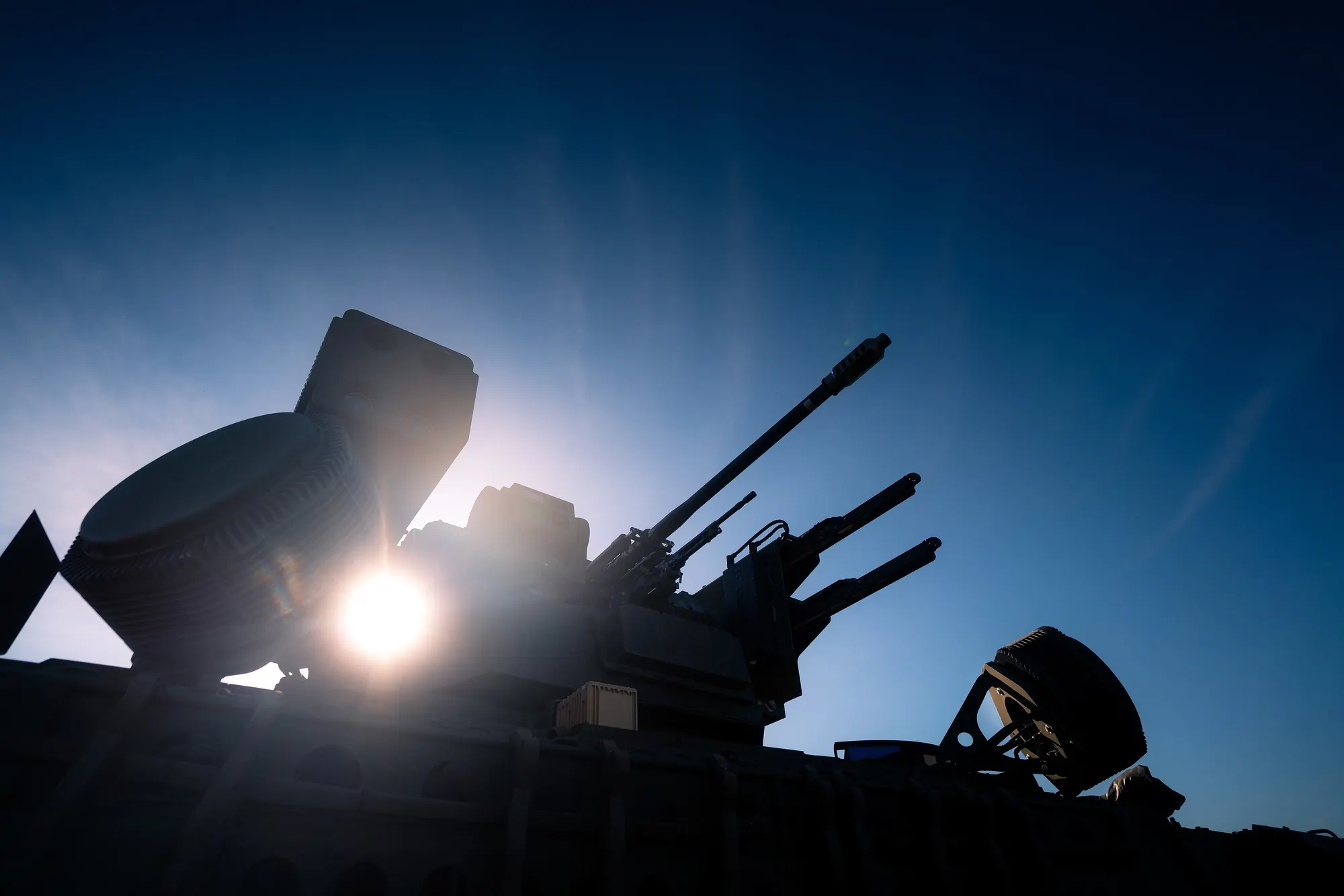
- Kinetic defeat. Interceptor missiles (RTX Coyote, AeroVironment FE-1, Singularity, Perseus), interceptor drones (Fortem DroneHunter, Askari, Mara) and guns with automated fire control (Allen Control Systems Bullfrog, SmartShooter, ZeroMark).
- Directed energy. High-energy lasers (Aurelius Systems) and high-power microwaves (Epirus Leonidas), which promise a very low cost per engagement once the system is bought.
Cost per shot is the central problem. The Army's 2024 Coyote buy works out to about $125,000 per interceptor, far more than many of the drones it is meant to stop. That gap is why investors are funding cheap interceptors, guns and directed energy, and why JIATF-401 buys from many vendors at once.
What to watch in counter-UAS
- Marketplace orders: the September 2026 IDIQs only set ceilings. The first task orders under JIATF-401's marketplace will show which sensors and effectors the services actually buy, and in what volume.
- Homeland deployments: with new counter-UAS authorities for trained state and local agencies and the November 2026 interagency agreement with the FAA, demand is spreading beyond military bases to stadiums, energy infrastructure and the southern border.
- Cheaper interceptors: watch whether startups such as Singularity Defense, Perseus Defense and Askari Defense win production orders, and whether lasers and microwaves move from tests to fielded units.
Related lists
Many of these companies also build or test drones: see our explainer on the Drone Dominance Program, the Blue UAS Cleared List, and electronic warfare startups. For missile defense at the national level, see Golden Dome companies and contracts.