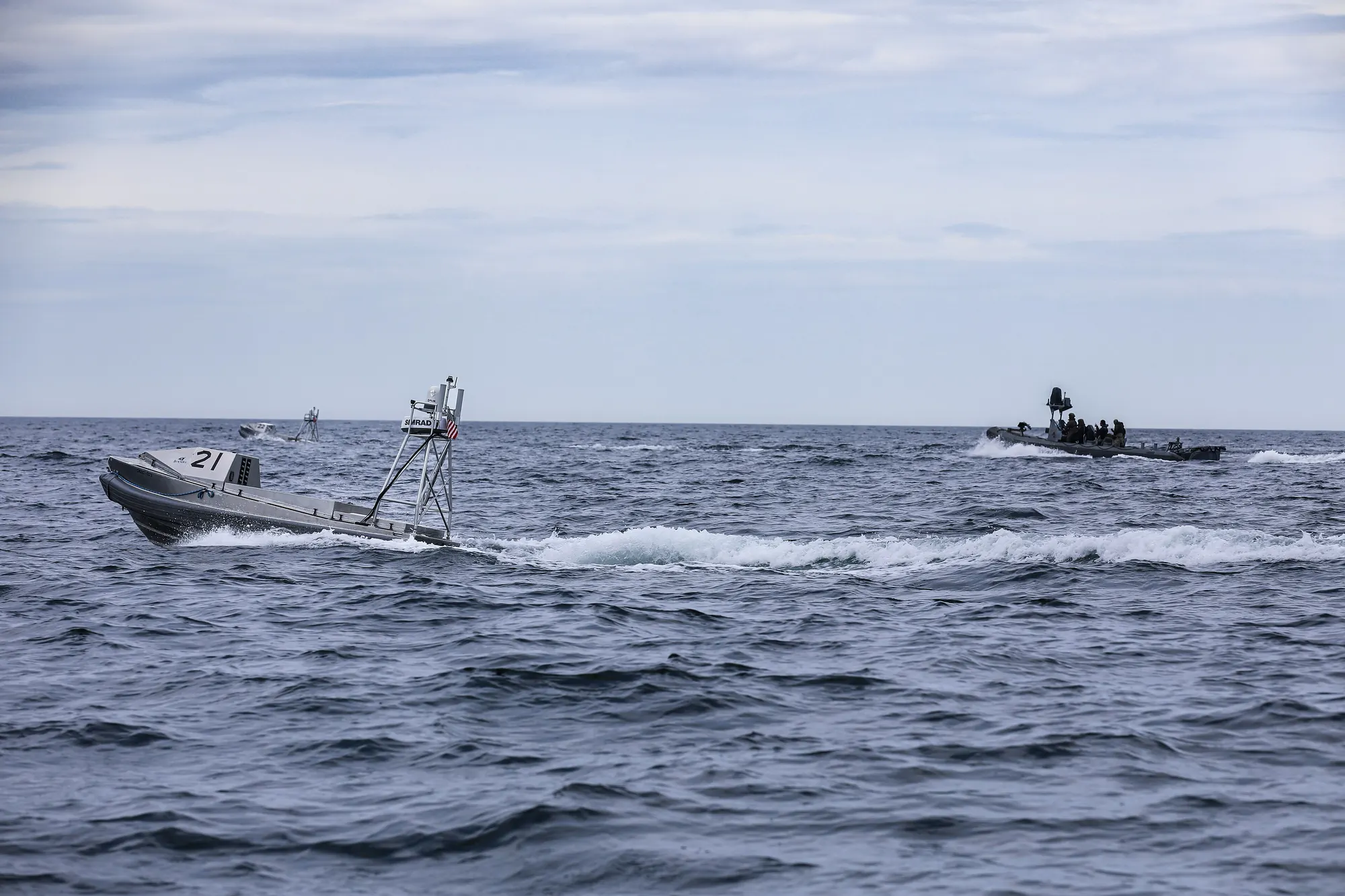
The leading US autonomous ship companies are Saronic, HII and Galliano Marine Services, the three firms that won Navy production deals on September 29, 2026 for 10 Medium Unmanned Surface Vessels each at an average of $40 million per vessel. Around them sit startups such as HavocAI, Saildrone and Blue Water Autonomy, and undersea makers led by Anduril and Boeing.
This list separates the three groups that most rankings mix up: venture-backed startups, established shipbuilders and public defense companies, and the Navy programs that decide who gets paid. It covers unmanned surface vessels (USVs), which ride on the water, and unmanned undersea vehicles (UUVs), also called autonomous underwater vehicles (AUVs). Every startup below has a profile in our maritime and underwater directory.
Navy unmanned vessel programs in 2026
The Navy changed how it buys drone ships in 2026. In March it cancelled the Modular Attack Surface Craft (MASC) program, a prototyping effort launched in 2025, and replaced it with a recurring "marketplace" that tests vessels companies have already built and then buys them in production. "MASC was a prototyping effort, not a production effort," Rebecca Gassler, the Navy's Portfolio Acquisition Executive for Robotic and Autonomous Systems, told USNI News on March 26, 2026. A Navy official said the 2025 reconciliation law contained nearly $5 billion for Navy unmanned programs, including $2.1 billion for medium USVs.
| Program | Type | Companies | Status (Nov 2026) |
|---|---|---|---|
| Medium Unmanned Surface Vessel (MUSV) Marketplace | Medium USV | Production: Galliano Marine Services, HII, Saronic. Completed prototype phase: Leidos, PAC MAR, Sea Machines | 30 vessels ordered Sep 29, 2026; first deliveries before end of FY2027; Phase II call for solutions issued Sep 23, 2026 |
| Modular Attack Surface Craft (MASC) | Medium USV | Several vendors down-selected in late 2025 | Cancelled March 2026, folded into the MUSV Marketplace |
| Global Autonomous Reconnaissance Craft (GARC) | Small USV | BlackSea Technologies (now part of AEVEX) | 325 delivered in 2025; contract about $350M through June 2027 (company) |
| Orca XLUUV | Extra-large UUV | Boeing | Shipbuilding plan funds 2 in FY2027 and 16 through FY2031 |
| Combat Autonomous Maritime Platform (CAMP) | Extra-large UUV | Anduril (Dive-XL) | Selected by DIU and the Navy Mar 12, 2026; value not disclosed |
Sources: US Navy (MUSV), USNI News (MASC), AEVEX via Business Wire (GARC), Army Recognition (Orca), Breaking Defense (CAMP).
The MUSV award in detail
The September 29, 2026 Navy release is the clearest public price signal for autonomous ships. Each of the three production Other Transaction (OT) agreements covers 10 MUSVs at an average procurement cost of $40 million per vessel, which by our arithmetic implies about $400 million per vendor and $1.2 billion for the 30 boats. Leidos, PAC MAR and Sea Machines completed their prototype agreements, receive $15 million each under the earlier terms, and join the Drones.mil Maritime Marketplace, where they can win follow-on production orders. "Our message to the defense industrial base is simple: build fast, deliver on time, and match the urgency of the threat," Acting Secretary of the Navy Hung Cao said in the release.
Autonomous ship and underwater drone startups
These companies are privately held, US-headquartered and founded in 2012 or later. Figures come from each company profile, which lists its sources.
| Company | HQ | What it builds | Latest funding or milestone |
|---|---|---|---|
| Saronic | Austin, TX | Autonomous surface vessels from the 24-foot Corsair to the 180-foot Marauder; Port Alpha shipyard | $1.75B Series D at $9.25B (Mar 2026); MUSV production award (Sep 2026) |
| HavocAI | Providence, RI | Autonomy software and fleets of small autonomous boats | $100M Series A (May 2026); over 100 vessels deployed |
| Saildrone | Alameda, CA | Wind and solar powered Explorer, Surveyor and Voyager USVs | $50M Lockheed Martin investment (Oct 2025); $16.3M Navy Voyager extension (Aug 2026) |
| Blue Water Autonomy | Boston, MA | Long-range autonomous ships of 100 to 150 feet | $50M Series A (Sep 2025) |
| Sea Machines Robotics | Boston, MA | Autonomy kits for existing boats; STORMRUNNER craft | Completed MUSV prototype phase, joins Maritime Marketplace (Sep 2026) |
| Seasats | San Diego, CA | Small solar-electric Lightfish and Quickfish USVs | $20M Series A (Feb 2026) |
| Vatn Systems | Bristol, RI | Skelmir low-cost AUVs that double as lightweight torpedoes | $60M Series A (Dec 2025) |
| Ulysses | San Francisco, CA | Mako underwater drones and the Leviathan surface mothership | $38M Series A (Apr 2026) |
| Corridian | Boston, MA | Ultra-large cargo AUVs for undersea logistics | $38M seed (Nov 2026) |
| Terradepth | Austin, TX | AUVs and Absolute Ocean seabed data software | Navy NIWC Atlantic transition (Apr 2026) |
| Albacore | Philadelphia, PA | Ghostfin autonomous mini-submarine | $6.5M seed (Oct 2025) |
Notes on the leaders
Saronic is the largest by capital and the only startup with a Navy MUSV production award. Its Marauder is the vessel behind that deal, and it is building Port Alpha, a shipyard in Brownsville, Texas planned with more than $3 billion of investment. Our Saronic valuation and IPO page covers its funding round by round.
HavocAI sells software first: its autonomy stack runs fleets of small boats and works across sea, air and ground platforms, and the company has bought Mavrik and Teleo. Saildrone, founded in 2012, is the oldest company here; Lockheed Martin invested $50 million in October 2025 to integrate defense payloads on its vessels. Blue Water Autonomy takes the opposite approach to small attritable boats, designing 100 to 150 foot ships from the keel up for long fleet missions.
Under the water, Vatn Systems says its Rhode Island factory can make up to 2,000 vehicles a year, and Corridian raised a $38 million seed in November 2026 for cargo-hauling AUVs. Sea Machines converts crewed vessels rather than building hulls, and is now on the Navy's Maritime Marketplace.
Anduril and the larger undersea players
Anduril is a startup by our definition but sits in a different weight class, valued at $61 billion. Its undersea line includes Ghost Shark, an extra-large AUV in production for Australia under a A$1.7 billion five-year contract; Dive-LD, used by the US Navy; Dive-XL, chosen for the CAMP project; and Copperhead, small AUVs and torpedoes launched from other drones. On October 6, 2026 it also announced Arsenal-2, a Maryland shipyard for Virginia-class submarine components. See our guide to Anduril's products and Arsenal-1 and Arsenal-2 explainer.
Boeing's Orca is the Navy's main extra-large UUV program of record. The Navy's fiscal 2027 (FY2027) shipbuilding plan, released in May 2026, funds two Orcas in FY2027 ($135.8 million) and 16 through FY2031, about $1.13 billion across the plan, Army Recognition reported. The vehicle is 51 feet long with a range of up to 6,500 nautical miles, according to the same report.
Public companies and primes in unmanned vessels
| Company | Ticker | Role in unmanned vessels (sourced) |
|---|---|---|
| HII | NYSE: HII | MUSV production award for 10 vessels (Sep 29, 2026) |
| Leidos | NYSE: LDOS | Completed MUSV prototype agreement; on the Maritime Marketplace |
| Boeing | NYSE: BA | Orca XLUUV; 16 planned through FY2031 |
| AEVEX | NYSE: AVEX | Acquired BlackSea Technologies (GARC) for up to $650M, announced Aug 13, 2026; Mako USV |
AEVEX agreed on August 13, 2026 to buy BlackSea Technologies for up to $650 million, $250 million in cash, about $350 million in AEVEX Class A stock and up to $50 million in earnouts, Breaking Defense reported. GARC is a 16-foot small autonomous vessel operated by the Navy's Unmanned Surface Vessel Squadron 3. AEVEX said on October 21, 2026 that the business delivered 325 GARCs to the Navy in 2025, that a GARC made the Navy's first autonomous live-fire strike by a small USV during RIMPAC 2026, and that "recent reports" of halted orders were wrong; those are company statements.
This article is for information only and is not investment advice.
USV vs UUV: what is the difference?
A USV operates on the surface and can use radio and satellite links, so it can be controlled or monitored in real time; missions include surveillance, strike, decoy work and carrying containerized payloads. A UUV operates under water, where radio does not reach, so it must navigate and decide more on its own; missions include seabed mapping, mine hunting, intelligence gathering and, in armed versions, torpedo-like strikes. Sizes run from small attritable boats and man-portable AUVs to the medium USVs of the MUSV program and extra-large UUVs such as Orca and Ghost Shark.
Autonomous shipbuilding startups: where the money goes
Building ships at scale needs yards, and two startups are building their own. Saronic bought a yard in Franklin, Louisiana in 2025 and is planning Port Alpha in Brownsville, while Anduril's Arsenal-2 targets submarine components at Sparrows Point, Maryland, with first operations planned for 2030. For startups making the parts and machines behind them, see our list of defense manufacturing startups. For the drones above the water, see military drone manufacturers in the USA.